Qmobile – EU Chat Control Law: Human Rights and Legal Assessment
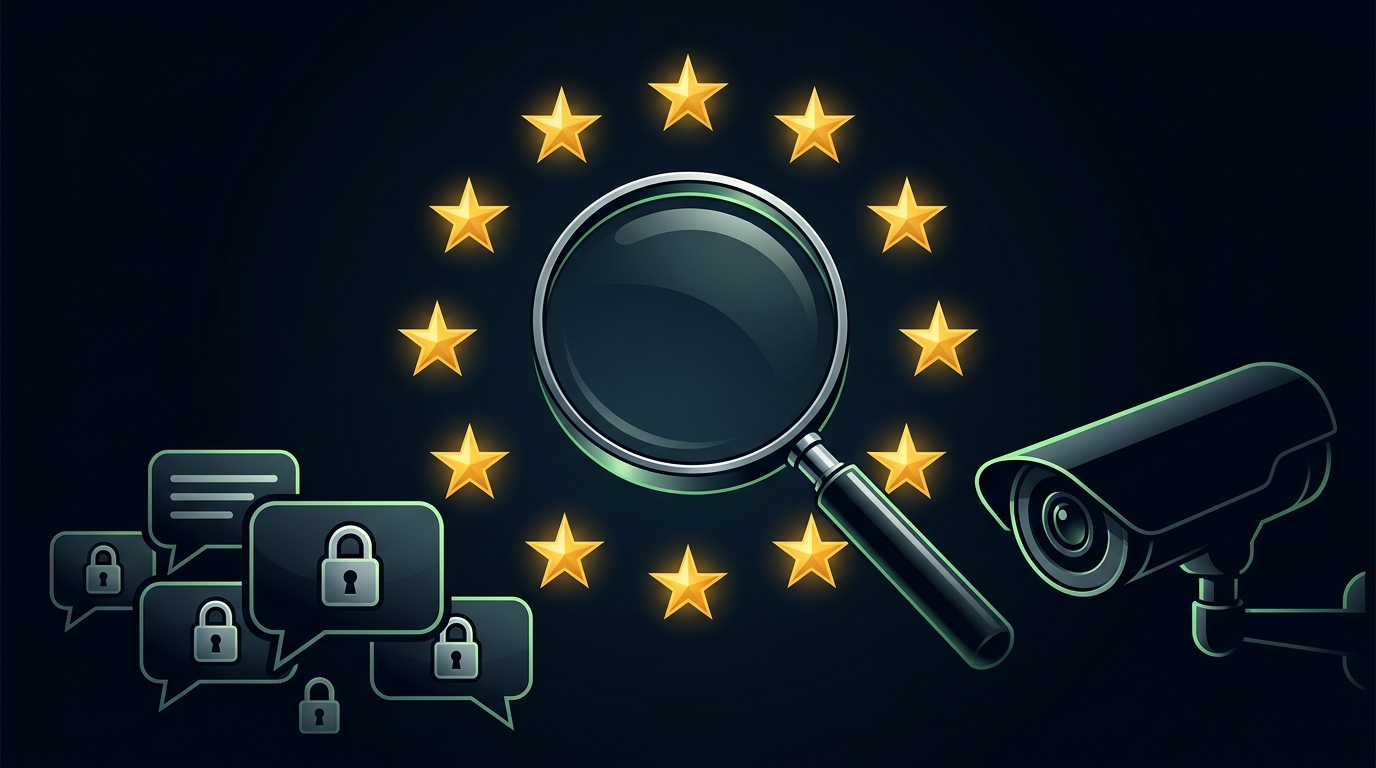
The EU Chat Control Law is a regulation compelling digital communication platforms to automatically scan user messages, photos, and files. Although the law is presented under the pretext of combating child abuse, it builds a surveillance infrastructure that comprehensively monitors every user's private communication.
This approach directly conflicts with fundamental human rights norms that prohibit arbitrary interference with private life and correspondence. In this article we assess the human rights, legal, and technical dimensions of the law and summarize Qmobile's privacy-focused solution.
1. The Human Rights Meaning of Mass Scanning
Article 12 of the Universal Declaration of Human Rights and Article 8 of the European Convention on Human Rights prohibit arbitrary interference with an individual's private life and correspondence. This protection is limited to targeted and proportionate interventions.
The Chat Control Law, however, automatically scans the messages and files on every user's device. This creates general and indiscriminate surveillance covering the communication of millions of people without any suspicion.
Mass scanning erodes the presumption of innocence: every user is treated as a potential offender and their private conversations are opened to state access. This is an unacceptable assumption from a human rights perspective.
2. Legal Assessment and the Principle of Proportionality
In a rule-of-law state, an intervention must be proportionate to be considered legitimate: the measure must not exceed the legitimate aim pursued and must be chosen so as to cause the least harm to fundamental rights.
Even though the Chat Control Law rests on a legitimate aim such as combating child abuse, it exceeds that aim by scanning the communication of all users. Instead of targeted and suspicion-based interventions, mass surveillance is applied.
The law must therefore be questioned under the principles of proportionality and necessity. In a democratic society, the blanket suspension of fundamental rights cannot be accepted as a legitimate intervention.
3. Conflicts with the EU Charter of Fundamental Rights
Article 7 of the EU Charter of Fundamental Rights guarantees respect for private and family life, and Article 8 protects personal data. Data processing is bound by the principles of explicit consent, necessity, and proportionality.
The Chat Control Law may perform on-device scanning without user consent and may weaken encrypted communication. This directly damages the guarantees of Articles 7 and 8 of the Charter.
Moreover, freedom of expression and information, protected by Article 11 of the Charter, is placed under surveillance; because users know their conversations are monitored, they tend toward self-censorship.
4. Surveillance and Privacy Erosion
The law builds an infrastructure that, in the name of fighting crime, scans the private conversations of all citizens. This infrastructure exceeds the targeted surveillance principle accepted in democratic societies and normalizes general surveillance.
On-device scanning makes individuals' political views, personal relationships, and private conversations examinable by the state. This leads to a narrowing of freedom of expression and to self-censorship.
For journalists, activists, and anyone who relies on source confidentiality, secure communication becomes effectively impossible. This is a serious loss for democratic oversight and public information.
5. Qmobile's Technical Security Architecture
As Qmobile, we address user privacy within the framework of the strong protection mechanisms of Swiss law. Switzerland is not a party to this EU regulation, and within the Qmobile ecosystem there is no on-device scanning, no backdoor, and no automatic data sharing.
The Qmobile solution offers a layered security architecture that technically prevents the implementation of a surveillance infrastructure. The following features protect user communication at the device and network level:
End-to-end encryption
Per-app locks and multiple profile support
Automatic self-destruct messages and remote wipe
Hardware verification and secure boot
App sandbox (isolation) and anti-tracking
Network security and fake base station protection
Forensic protection and hide lock content
This architecture technically prevents the implementation of the on-device scanning systems envisioned by the EU and preserves the user's control over their communication.
6. Conclusion and Protect Your Communication with Qmobile
Although the EU Chat Control Law rests on a legitimate aim such as combating child abuse, its mode of application conflicts with fundamental human rights, the principle of proportionality, and the integrity of encrypted communication.
Qmobile will continue to protect the confidentiality of users' communication and to offer solutions that comply with Switzerland's high privacy standards. To protect your communication from surveillance, explore the Qmobile devices. Why Qmobile? | Security and Privacy: https://qmobile.ch/why